Math in Motion • Week 1

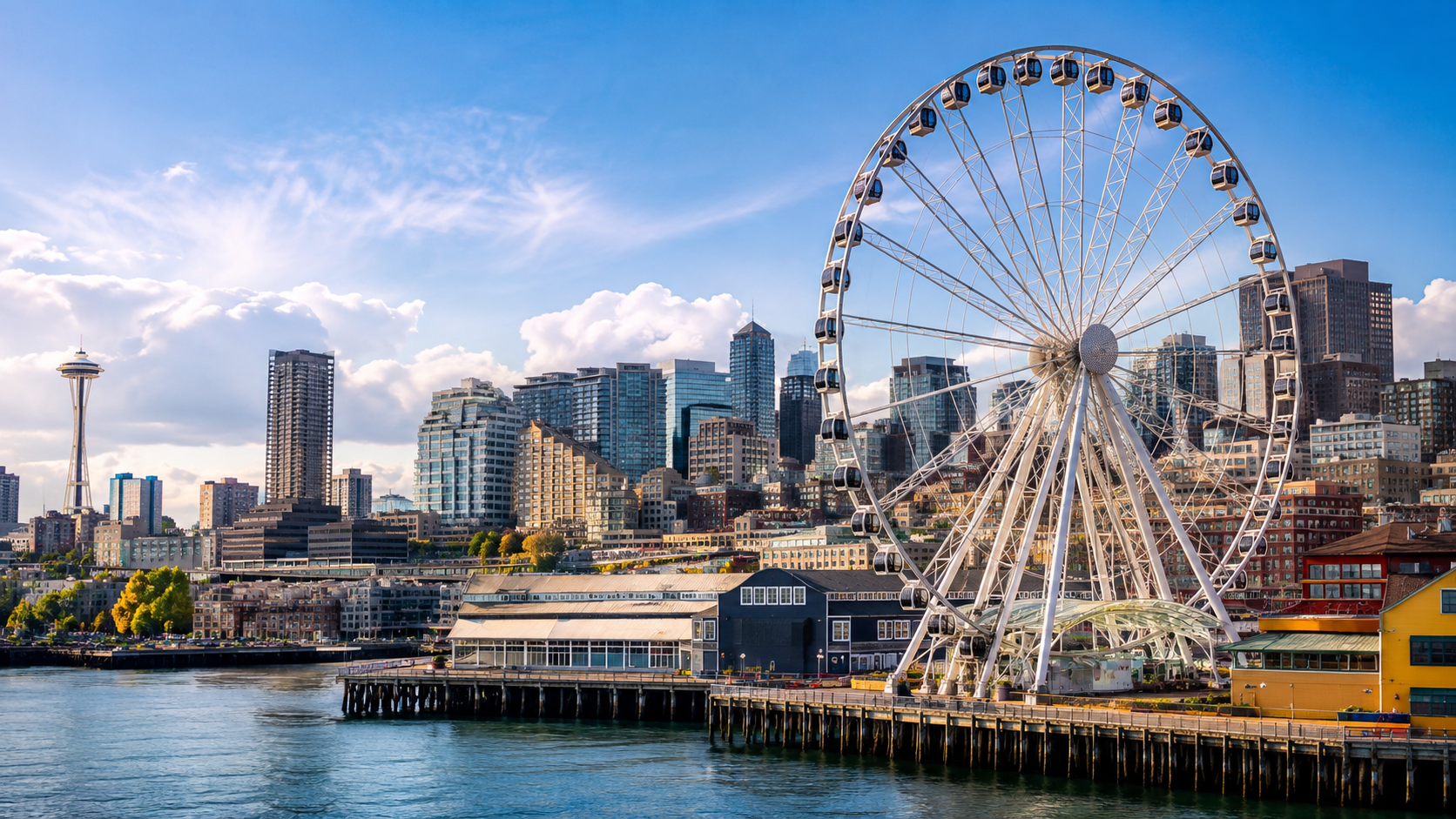
The Seattle Great Wheel

My class and I visited the Seattle Great Wheel, rode it, took pictures and video, and then used circular motion to build a mathematical model of what we saw.

During the steady part of our ride, our video suggested that one revolution took about 124 seconds. That observation gave us the basic clock for the model.

We built the wheel together first. Then students added motion, images, and their own ideas to the Seattle scene.

Seattle Great Wheel
Model Radius 78 ft Radius used in our Desmos model
Center Height 97 ft Height used in our Desmos model
Revolution Time ≈ 124 sec Estimated from our own video
Gondolas 42 The real Great Wheel has 42 cabins
Rider Speed ≈ 2.7 mph During our modeled steady-speed motion
1

Visit, observe, build

We started at the real Great Wheel and brought what we saw back to the classroom.

My class and I went to Pier 57, rode the Great Wheel, and collected pictures, video, and observations. We estimated about 124 seconds per revolution during steady motion, then used circular motion to build the wheel in Desmos. Once the shared model worked, students extended it with their own motion and visual ideas.

Ride Observe Model Extend
Math in Motion class visit to the Seattle Great Wheel
Our class at the waterfront—the visit that started this build.
2

The shared class model

Once the wheel was moving, the assignment opened up: add something else that moves. The animation below combines a selection of those student ideas into one scene.

0.0 s • Day
The real wheel does not move this quickly. Our full 372-second mathematical scene is compressed into about 80 seconds of viewing time, so one modeled 124-second wheel revolution takes about 27 seconds on this page. The graph itself is locked; use only Play/Pause or the time slider.

What the class added

Different students explored different kinds of motion and visual storytelling. I collected several of those contributions here rather than presenting the work as one person's finished design. The scene is intentionally playful: it is a showcase of modeling ideas, not a literal record of one moment on the Seattle waterfront.

Walking riders Timed boarding Boats Plane Seagulls Ducks Day & night Wheel lights Images & backgrounds
3

What does 124 seconds tell us?

Once we know the time for one revolution, we can turn our observation into angular speed, position equations, and an estimate of how fast a rider is moving.

The clock for the wheel

One full revolution is \(2\pi\) radians. If that takes 124 seconds, then the constant angular speed in our model is

\[ \omega =\frac{2\pi}{124} =\frac{\pi}{62} \approx 0.0507\text{ rad/s}. \]

A gondola can then be placed with the familiar circular-motion equations \(x=R\cos(\theta)\) and \(y=H+R\sin(\theta)\), with the angle changing as \(\theta=\theta_0+\omega t\).

How fast is a rider traveling?

Using the 78-foot radius in our model, the rider travels approximately 490 feet in one revolution.

\[ v=R\omega =78\left(\frac{\pi}{62}\right) \approx 3.95\text{ ft/s} \approx 2.69\text{ mph}. \]

That is the modeled speed during the steady part of the ride. The actual Great Wheel also speeds up, slows down, and stops while passengers load and unload.

4

Inside the Great Wheel

Some of our favorite facts are the ones you cannot see at first glance: what holds the wheel up, what turns it, and what is special about a few of the gondolas.

The Great Wheel looks like one enormous machine, but its engineering depends on some surprisingly simple ideas: a very deep foundation, friction at the rim, and a collection of individual gondolas moving together around one circle.

≈ 100 ft

Below the mud line

The foundation is supported by 53 steel piles about 3 feet in diameter. Jackson | Main describes the piles as extending roughly 100 feet below the water's mud line; they were filled with reinforced concrete.

4

Small drive wheels

The giant wheel is not powered by a huge motor at its center. Four comparatively small drive wheels at the bottom press against the rim and turn the structure by friction.

#12

A Seattle gondola

Gondola 12 was given a Seahawks-themed No. 12 design in honor of Seattle's "12s" and the 12th Man tradition. It is the special No. 12 cabin shown in our model.

#42

The VIP gondola

Cabin 42 is the VIP gondola. It seats up to four adults and includes leather bucket seats, a stereo, a glass-bottom floor, and cup holders.

What is the ride itself like?

A normal ride includes three complete revolutions. The enclosed, climate-controlled gondolas make the ride usable year-round; the 41 standard cabins can hold up to eight adults each, while the VIP cabin seats four.

HistoryLink describes a ride as lasting roughly 10–20 minutes, depending in part on loading and unloading. That is much longer than three uninterrupted turns at the steady speed we measured.

During our constant-speed observation, one turn took about 124 seconds. So three uninterrupted turns at that speed would take only 372 seconds, or 6.2 minutes. The difference is a useful reminder: our circular-motion model captures the steady part of the ride, while the real wheel also slows, stops, loads, and unloads passengers.

3 × 124 s = 372 s Three steady revolutions in our model
= 6.2 minutes

A young Seattle landmark

The Seattle Great Wheel opened on June 29, 2012 at Pier 57. Hal Griffith had imagined a waterfront Ferris wheel for nearly 30 years before realizing that one could be built on his family's own pier.

The wheel weighs 280,300 pounds; its foundation used about 550 tons of concrete. The structure extends nearly 40 feet beyond the end of the pier over Elliott Bay. At night, more than 500,000 programmable LED lights turn the wheel into a moving light display—which is one reason a night scene fit our class build so well.
Where It Started

A real ride, some video, a circle, 42 gondola positions, and one question: how can we describe what we are seeing?

What We Were Practicing

Observe something real, decide what matters, make a mathematical model, visualize it, and then use the model to ask new questions.

Where This Goes Next

This page currently shows our 2D class scene. A 3D Great Wheel model can be added later as the next step in the same story.