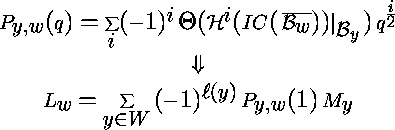
Click on the formula to find out it's significance.
Highest weight representations arise naturally on the level of the associated Lie algebra. One can study these highest weight representations in isolation, in the context of modules over the enveloping algebra of a reductive Lie algebra. On the other hand, many problems in highest weight representation theory are either directly or indirectly linked to problems in Lie group representation theory. For example, Harish-Chandra built a family of unitary representations having discrete Plancherel measure which turn out to be highest weight representations; these are studied in [10] and [11]. For another example, the famous Kazhdan-Lusztig conjectures (1980) delt with describing the composition factors of highest weight representations. Many of the ideas used in the proof of these conjectures were then carried over to the Lie group setting by Lusztig-Vogan.
My own work on highest weight representations began with the papers [8,9] (with Brian Boe), where a connection between highest weight representations and Lie group representations was developed and used to prove the existence of a collection of differential operators between vector bundles. The work in [10] (with Brian Boe) looks at the Hermitian symmetric case and proves a multiplicity one theorem As noted above, these highest weight representations are famous, going back to Harish-Chandra's early work on the discrete portion of the Plancherel measure for a reductive Lie group. The work in [17] (with Ron Irving and Brad Shelton) goes on to describe more thoroughly the structure of these highest weight representations, playing off the techniques in the paper [16] quoted above. The natural maps between highest weight representations give rise to differential operators between vector bundles. The paper [11] (again with Brian Boe) was the beginning of a series which ultimately classified all such operators. Finally, [15] (with Luis Casian) describes how to formulate and prove a Kazhdan-Lusztig conjecture in a more general setting.