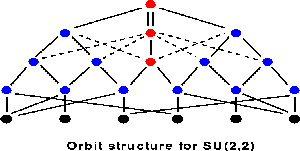
 Click on picture for significance.
My work with Luis Casian in [16] offers a fundamental new approach to studying the structure and properties of induced representations. The techniques used are of a geometric nature and involve describing the so-called weight filtration for an induced representation. This tells us how the various irreducible pieces fit together inside the induced representation. The results of this paper were made explicit in a special case in an earlier book [7] and the AMS Memoir [18], where the so-called real rank one case is discussed; this is an important testing ground for ideas and conjectures. My work with Brian Boe in the AMS Memoir [26] sheds new light on the structure of a particularly important class of induced representations and makes progress on a long standing problem of Vogan. (Problem #3 in the back list of problems in his book Representations of real reductive Lie groups, Birkhauser 1981. ) The work in [6] focuses on describing irreducible representations where an analog of Kostant's famous cohomology result (used to prove the Borel-Weil-Bott Theorem) holds.